Salary Negotiation Tips: How to Ask for a Higher Salary With Confidence (Complete Guide) | 2026
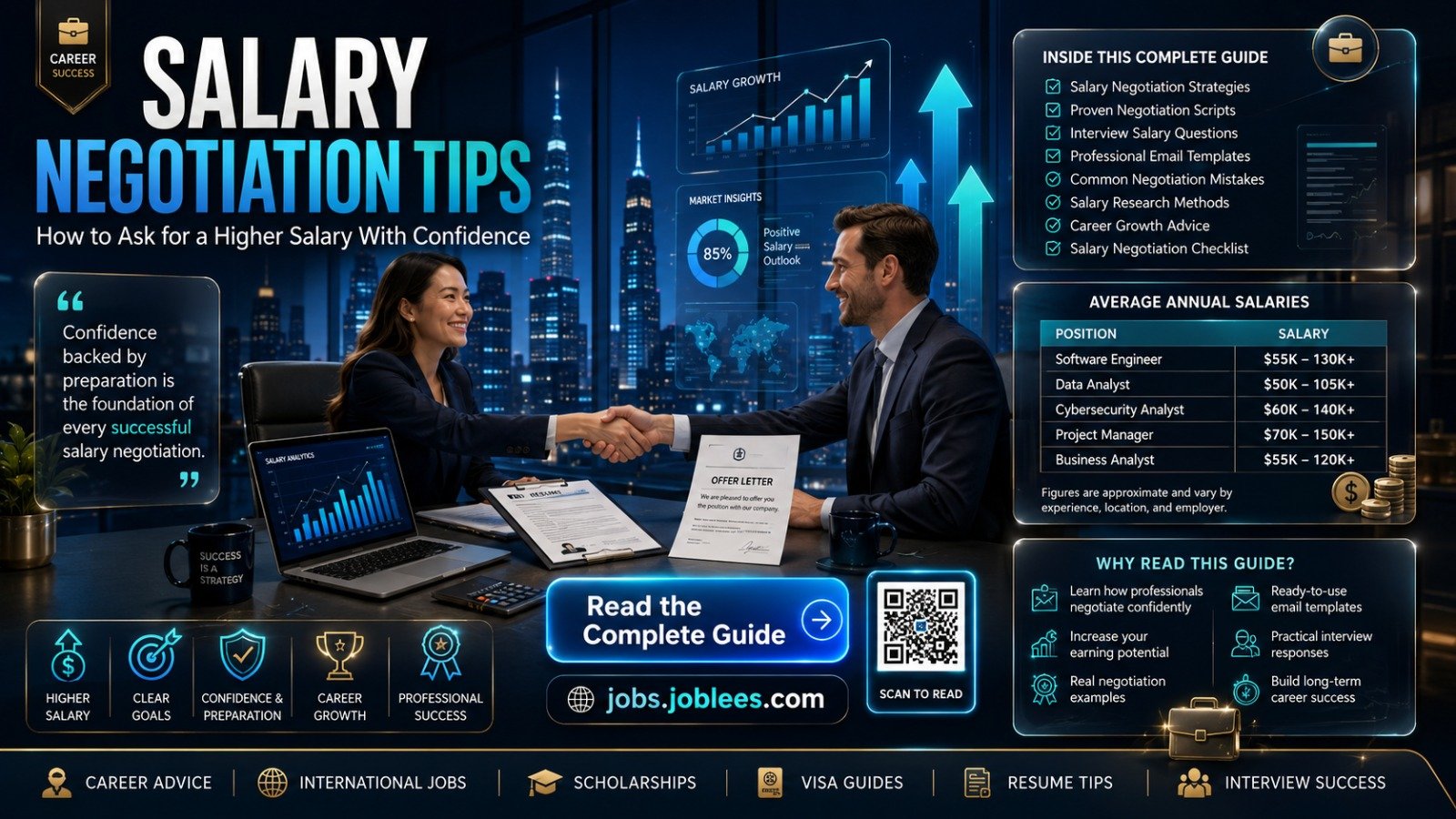
Learn how to ask for a higher salary with confidence in 2026 using proven negotiation strategies, salary research, and professional communication tips. Discover the best ways to prepare for salary discussions, highlight your achievements, and increase your chances of earning the pay you deserve with this complete career guide from Joblees.com.
Salary Negotiation Tips: How to Ask for a Higher Salary With Confidence
Getting a job offer is exciting, but many people make one costly mistake—they accept the first salary offered without asking whether there’s room for negotiation.
The truth is that salary negotiation is a normal part of the hiring process in many industries. Employers often expect candidates to ask questions about compensation, especially for professional roles. Negotiating respectfully can sometimes lead to a higher salary, better benefits, or additional perks without affecting your chances of getting the job.
Whether you’re applying for your first position or you’re an experienced professional looking for a better package, learning how to negotiate your salary can have a lasting impact on your career. Even a modest increase can add up to thousands of dollars over the course of several years.
In this guide, you’ll learn practical salary negotiation tips, common mistakes to avoid, and simple strategies you can use before accepting your next job offer.
Also Read: https://jobs.joblees.com/complete-guide-to-car-insurance/
What Is Salary Negotiation?
Salary negotiation is the process of discussing your compensation with an employer before accepting a job offer or during a performance review.
Compensation isn’t limited to your monthly salary. It may also include:
- Performance bonuses
- Annual salary reviews
- Health insurance
- Paid leave
- Flexible working hours
- Remote work options
- Professional training
- Retirement benefits
- Relocation assistance
Sometimes an employer cannot increase the salary but may be willing to improve other parts of the compensation package.
Why Salary Negotiation Is Important
Many job seekers worry that negotiating will make them look demanding or ungrateful. In reality, respectful negotiation is common in many workplaces.
Here are a few reasons why it matters:
It Increases Your Lifetime Earnings
Imagine two software developers receive job offers.
- Candidate A accepts $60,000 immediately.
- Candidate B negotiates and receives $66,000.
That $6,000 difference doesn’t just apply to the first year. Future raises, bonuses, and retirement contributions are often based on your current salary. Over several years, the difference can become substantial.
It Shows Professional Confidence
Negotiating professionally demonstrates that you:
- Understand your skills.
- Have researched the market.
- Can communicate effectively.
- Value your work.
These are qualities many employers appreciate.
It Can Improve More Than Salary
If an employer cannot increase the salary, you might negotiate for:
- Additional vacation days
- Signing bonus
- Remote work flexibility
- Professional certification funding
- Better equipment
- Flexible schedule
- Performance review after six months
Sometimes these benefits can be just as valuable as a higher salary.
Should You Always Negotiate?
Not every situation requires negotiation.
It usually makes sense to negotiate when:
- You’ve received a formal job offer.
- Your experience exceeds the job requirements.
- The salary offered is below the market average.
- You have another job offer.
- You have specialized skills that are difficult to find.
You may choose not to negotiate if:
- The employer clearly states the salary is fixed.
- It’s a government position with predetermined pay scales.
- You’re comfortable with the offer and the overall benefits package.
- Negotiating could jeopardize a rare opportunity, and you have little leverage.
Every situation is different. The key is to remain polite and professional throughout the conversation.
Prepare Before You Negotiate
Preparation is the biggest difference between a successful negotiation and an unsuccessful one.
Before discussing salary, answer these questions:
- What is the average salary for this role?
- What salary range would make you happy?
- What is the minimum salary you’ll accept?
- What unique skills do you bring?
- Can you explain how you’ve created value in previous roles?
Write your answers down. This exercise helps you speak with confidence instead of relying on emotions during the discussion.
Research the Market Salary
Never negotiate based on guesswork.
Instead, research salaries using reliable sources such as:
- Company career pages
- Government labor statistics
- Professional networking platforms
- Salary comparison websites
- Industry reports
When researching, consider:
- Country
- City
- Industry
- Years of experience
- Education
- Certifications
- Company size
For example, a software engineer in Berlin may earn a different salary than someone with the same title in Dubai or Toronto. Location, industry, and experience all influence compensation.
Understand Your Professional Value
Employers don’t pay people simply because they ask for more money. They pay for the value those people bring to the organization.
Think about what makes you stand out.
Ask yourself:
- Have I completed important projects?
- Did I help reduce costs?
- Have I improved productivity?
- Did I increase sales or customer satisfaction?
- Do I have certifications that are valuable for this role?
- Can I solve problems that others cannot?
The more evidence you can provide, the stronger your negotiation becomes.
Instead of saying:
“I want more money.”
Say something like:
“Based on my experience managing similar projects and the current market range for this position, I’d like to discuss whether there’s flexibility in the compensation package.”
That approach focuses on value rather than emotion, making it more persuasive.
Choose the Right Time to Negotiate
Timing plays a major role in successful salary negotiations. Even a strong case can be less effective if you bring it up too early.
The best time to discuss salary is after you’ve received a job offer. At that stage, the employer has decided you’re the candidate they want, which gives you more room to have a productive conversation.
If you’re already employed, the ideal time to negotiate is:
- During your annual performance review
- After completing a major project successfully
- When you’ve taken on additional responsibilities
- After earning a valuable certification
- When you’ve consistently exceeded your performance goals
Avoid asking for a raise when:
- The company is going through layoffs or financial difficulties.
- You’ve only been in the role for a short time without clear achievements.
- Your performance hasn’t met expectations.
- The employer has clearly explained that salary reviews happen at specific times of the year.
Patience and good timing often lead to better outcomes than rushing the conversation.
Proven Salary Negotiation Strategies
There isn’t a single approach that works for every situation. The key is to stay professional, respectful, and focused on facts.
1. Let the Employer Make the First Offer
Whenever possible, avoid mentioning a specific number before receiving an offer.
Once the employer has shared their salary range, you’ll have a better understanding of their budget. This also reduces the chance of asking for less than they were prepared to pay.
2. Base Your Request on Research
Instead of saying:
“I think I deserve more.”
Try saying:
“Based on my research and the responsibilities of this role, similar positions in this location typically offer a higher salary range. I’d appreciate discussing whether there’s flexibility in the compensation.”
This approach shows you’ve done your homework and keeps the discussion professional.
3. Focus on Value, Not Personal Expenses
Employers are interested in the value you bring to the business, not your personal financial situation.
Avoid statements like:
- “My rent has increased.”
- “I need more money for my family.”
- “Everything is getting expensive.”
Instead, highlight:
- Your skills
- Your experience
- Your certifications
- Your achievements
- Your ability to solve problems
- The results you’ve delivered
4. Be Flexible
Salary is only one part of a compensation package.
If the employer cannot increase your salary, consider discussing:
- Performance bonuses
- Annual salary reviews
- Extra paid vacation
- Flexible working hours
- Remote or hybrid work
- Professional training
- Conference attendance
- Health insurance
- Relocation support
- Stock options (where applicable)
Sometimes these benefits can significantly improve your overall package.
5. Stay Calm and Professional
Negotiation should feel like a discussion, not an argument.
Speak confidently, listen carefully, and avoid interrupting. If the employer needs time to review your request, thank them and wait for their response.
Professionalism leaves a positive impression, regardless of the outcome.
What to Say During Salary Negotiation
Many people know they want to negotiate but struggle to find the right words.
Here are a few examples you can adapt to your situation.
Example 1: General Salary Discussion
“Thank you for the offer. I’m genuinely excited about the opportunity to join your team. Based on my experience, skills, and current market rates for similar positions, I was hoping we could discuss whether there’s flexibility in the salary.”
Example 2: Experienced Professional
“I appreciate the offer. After reviewing the responsibilities and considering my experience managing similar projects, I believe a salary closer to the upper end of the range would better reflect the value I can bring to the role.”
Example 3: Recent Graduate
Even if you’re applying for your first job, you can still negotiate politely.
“Thank you for the offer. I’m excited to begin my career with your company. I understand I’m at the start of my professional journey, but considering my academic background, internships, and technical skills, I’d like to discuss whether there’s room for adjustment in the starting salary.”
Negotiating During an Interview
Sometimes an interviewer asks:
“What are your salary expectations?”
Instead of giving a random number, try one of these responses.
Option 1
“I’d like to learn more about the responsibilities of the role before discussing a specific number. I’m confident we can agree on a fair compensation package if we’re a good fit.”
Option 2
“Based on my research and experience, I’m looking for a salary that’s competitive with similar positions in this market. I’m open to discussing the complete compensation package.”
Option 3
“I’d be interested in hearing the budgeted salary range for this position before sharing my expectations.”
These responses keep the conversation open and encourage the employer to provide more information.
How to Respond if the Employer Says “No”
Not every negotiation results in a higher salary, and that’s okay.
If the employer says the salary is fixed, avoid reacting emotionally.
Instead, ask thoughtful questions such as:
- “Could this salary be reviewed after six months based on performance?”
- “Are there opportunities for performance bonuses?”
- “What does the promotion process look like?”
- “Are there additional benefits that could be included in the package?”
This shows you’re interested in growing with the company and thinking long term.
Common Salary Negotiation Mistakes
Learning what to avoid is just as important as knowing what to say.
Accepting the First Offer Immediately
Some employers expect candidates to ask questions about compensation. Taking a little time to review the offer is completely reasonable.
Negotiating Without Research
If you don’t know the typical salary range for your role, it’s difficult to make a strong case.
Research first, then negotiate.
Being Aggressive
Confidence is important, but respect is essential.
Avoid:
- Making demands
- Comparing yourself negatively to coworkers
- Threatening to reject the offer immediately
- Speaking emotionally or defensively
A calm, respectful tone is much more effective.
Talking Too Much
Once you’ve explained your reasoning, give the employer time to respond.
Silence can feel uncomfortable, but rushing to fill it often weakens your position.
Ignoring the Entire Compensation Package
A slightly lower salary may still be an excellent offer if it includes valuable benefits such as bonuses, flexible work arrangements, generous leave, or professional development opportunities.
Look at the full picture before making your decision.
Salary Negotiation Email Template
Not every salary discussion happens over the phone or in person. Many employers send a written offer by email, giving you time to review the details before responding.
A good negotiation email should be:
- Polite
- Positive
- Professional
- Clear
- Focused on your value
Remember, the goal isn’t to demand a higher salary. It’s to start a constructive conversation.
Example Salary Negotiation Email
Hello [Hiring Manager’s Name],
Thank you for offering me the position of [Job Title]. I’m grateful for the opportunity and excited about the possibility of joining your team.
After reviewing the offer and considering the responsibilities of the role, my experience, and current market rates for similar positions, I’d like to discuss the salary. I was hoping we could consider a salary of [Your Desired Amount].
I’m confident that my skills in [mention one or two relevant skills or achievements] will allow me to make a positive contribution to your team from the beginning.
I appreciate your time and consideration, and I look forward to discussing the offer further.
Kind regards,
[Your Name]
Follow-Up Email After Negotiation
Sometimes the employer needs a few days to review your request. If you haven’t received an update after about a week, it’s appropriate to send a polite follow-up.
Example Follow-Up
Hello [Hiring Manager’s Name],
I hope you’re doing well.
I wanted to follow up regarding our recent conversation about the job offer. I’m still very excited about the opportunity to join your team and wanted to check if there are any updates regarding the compensation discussion.
Thank you for your time, and I look forward to hearing from you.
Best regards,
[Your Name]
Salary Negotiation Tips for Fresh Graduates
Many graduates believe they have no negotiating power because they don’t have years of work experience. While your leverage may be different from an experienced professional, you can still negotiate respectfully.
Focus on the strengths you do have, such as:
- A strong academic record
- Relevant internships
- Technical skills
- Personal projects
- Leadership experience in university clubs
- Certifications
- Volunteer work
- Communication skills
If you’re just starting your career, avoid asking for a significantly higher salary without a clear reason. Instead, ask thoughtful questions about future growth.
For example:
“If the starting salary is fixed, would there be an opportunity for a performance review after six months?”
This shows you’re motivated to perform well and interested in long-term development.
Salary Negotiation Tips for Experienced Professionals
If you already have several years of experience, your negotiation should be backed by measurable achievements.
Instead of simply listing your responsibilities, explain the results you’ve delivered.
For example:
- Increased sales by 25%
- Reduced project costs by 15%
- Managed a team of 20 employees
- Improved customer satisfaction scores
- Delivered projects ahead of schedule
- Introduced a process that saved time or money
Employers respond more positively to evidence than to general statements.
Negotiating for Remote Jobs
Remote work has created opportunities to apply for jobs around the world, but it has also made salary discussions more complex.
Some companies pay based on:
- Your location
- The company’s headquarters
- Global salary bands
- Local market rates
Before negotiating, research how the employer structures compensation.
Useful questions include:
- Is the salary based on my country or the company’s location?
- Are there additional benefits for remote employees?
- Is there a home office allowance?
- Are internet or equipment costs covered?
Understanding the complete package helps you make an informed decision.
Negotiating International Job Offers
If you’re applying for jobs abroad, salary is only one part of the financial picture.
You should also ask about:
- Relocation assistance
- Visa sponsorship
- Accommodation support
- Health insurance
- Annual flight allowance
- Pension contributions
- Paid holidays
- Tax obligations
- Cost of living in the destination country
A salary that looks attractive at first may feel very different once living expenses are taken into account.
Industry-Specific Advice
Different industries have different expectations when it comes to salary negotiations.
Information Technology (IT)
Technology companies often value practical skills, certifications, and project experience.
If you’ve worked with in-demand technologies, completed successful projects, or solved complex technical problems, highlight those achievements during the discussion.
Business and Finance
Employers in business roles often appreciate candidates who can demonstrate measurable impact.
Focus on results such as:
- Revenue growth
- Cost savings
- Process improvements
- Client retention
- Successful negotiations
- Team leadership
Healthcare
Healthcare professionals can strengthen their case by highlighting:
- Specialized certifications
- Years of clinical experience
- Patient care improvements
- Leadership responsibilities
- Additional training
Engineering
Engineers should emphasize:
- Technical expertise
- Major completed projects
- Safety improvements
- Process optimization
- Cost reductions
- Industry certifications
Specific examples make your request more convincing than general statements.
Real-Life Example
Imagine two candidates applying for the same position.
Candidate A immediately accepts the first offer without asking any questions.
Candidate B thanks the employer for the offer, explains that they’ve researched the market, highlights relevant achievements, and respectfully asks whether there’s flexibility in the salary.
Even if Candidate B doesn’t receive the exact amount requested, they may still receive a higher salary, a signing bonus, or additional benefits simply because they started the conversation professionally.
The key lesson is that respectful negotiation isn’t about demanding more—it’s about discussing your value in a constructive way.
Advanced Salary Negotiation Techniques
Once you’ve mastered the basics, a few advanced strategies can help you handle negotiations with greater confidence.
1. Think About the Entire Compensation Package
A job offer is more than just the monthly salary. Before making a decision, consider everything that’s included.
Ask yourself:
- Is there an annual bonus?
- Are there regular salary reviews?
- Does the company provide health insurance?
- Are training courses or certifications covered?
- Is there flexibility to work remotely?
- How many paid vacation days are offered?
- Are there retirement or pension contributions?
- Does the company offer relocation support?
Sometimes a slightly lower salary can still be the better overall offer if the benefits are strong.
2. Be Ready With a Salary Range
Instead of giving one exact number, provide a realistic range based on your research.
For example:
“Based on my experience and the responsibilities of this role, I believe a salary in the range of $55,000 to $60,000 would be appropriate.”
A range shows flexibility while still communicating your expectations.
3. Practice Before the Conversation
Many people feel nervous because they haven’t practiced.
Before your meeting:
- Read your key points out loud.
- Practice with a friend or family member.
- Prepare answers to common questions.
- Keep your explanations short and focused.
The more prepared you are, the more confident you’ll sound.
4. Stay Positive Throughout
Negotiation is a conversation, not a competition.
Even if the employer cannot meet your request, thank them for considering it.
A positive attitude helps build trust and leaves a good impression.
Salary Negotiation Checklist
Before accepting any job offer, go through this checklist.
✅ I researched the average salary for the role.
✅ I understand the responsibilities of the position.
✅ I know the minimum salary I’m willing to accept.
✅ I prepared examples of my skills and achievements.
✅ I reviewed the full compensation package.
✅ I practiced what I want to say.
✅ I remained professional and respectful throughout the discussion.
Sample Salary Comparison Table (Approximate Annual Salaries)
| Job Title | Entry-Level Salary | Mid-Level Salary | Senior-Level Salary | Typical Location |
| Software Engineer | $55,000 | $85,000 | $130,000+ | Germany |
| Data Analyst | $50,000 | $75,000 | $105,000+ | Germany |
| Cybersecurity Analyst | $60,000 | $90,000 | $140,000+ | Canada |
| DevOps Engineer | $70,000 | $105,000 | $150,000+ | Canada |
| Cloud Engineer | $65,000 | $100,000 | $145,000+ | Australia |
| Business Analyst | $55,000 | $80,000 | $120,000+ | United Kingdom |
| Digital Marketing Manager | $45,000 | $70,000 | $110,000+ | UAE |
| Registered Nurse | $50,000 | $75,000 | $100,000+ | Australia |
| Mechanical Engineer | $55,000 | $80,000 | $120,000+ | Germany |
| Civil Engineer | $50,000 | $75,000 | $115,000+ | Qatar |
| Financial Analyst | $60,000 | $85,000 | $125,000+ | Canada |
| Project Manager | $70,000 | $100,000 | $150,000+ | Germany |
| Human Resources Manager | $55,000 | $80,000 | $120,000+ | UAE |
| Accountant | $45,000 | $65,000 | $95,000+ | Australia |
| IT Support Specialist | $45,000 | $65,000 | $90,000+ | Germany |
Average Monthly Salaries by Country
| Country | Approximate Monthly Salary (USD) |
| Germany | $4,500–$6,500 |
| Canada | $4,000–$6,000 |
| Australia | $4,500–$7,000 |
| United Kingdom | $3,800–$6,000 |
| United Arab Emirates | $3,500–$7,500 |
| Qatar | $3,500–$6,500 |
| Saudi Arabia | $3,000–$6,000 |
| Netherlands | $4,200–$6,500 |
Frequently Asked Questions
Is it okay to negotiate salary for your first job?
Yes. Even if you’re a recent graduate, it’s acceptable to ask respectful questions about compensation. Keep your expectations realistic and focus on your education, internships, projects, certifications, and the value you can bring.
Can negotiating salary cause an employer to withdraw the offer?
In most cases, a polite and professional negotiation does not lead to an offer being withdrawn. Problems are more likely if a candidate makes unreasonable demands, behaves disrespectfully, or refuses to compromise.
How much more should I ask for?
There isn’t a universal percentage that fits every situation. Your request should be based on:
- Market research
- Your experience
- Your qualifications
- The responsibilities of the role
- The overall compensation package
A well-supported request is usually more effective than choosing a random number.
What if the company says the salary is fixed?
If the salary cannot be changed, ask whether there are other benefits that can be discussed, such as:
- Performance bonuses
- Additional paid leave
- Flexible working hours
- Remote work options
- Professional development opportunities
- A scheduled salary review after your probation period
Should I negotiate every job offer?
Not necessarily.
If the offer already matches your expectations and the benefits are excellent, you may decide to accept it without negotiating.
However, if you believe your skills, experience, or market research support a higher salary, it’s reasonable to have a respectful discussion.
Key Takeaways
Salary negotiation is a professional skill that can benefit you throughout your career. Employers often expect candidates to ask thoughtful questions about compensation, and preparing in advance can make the conversation much easier.
Remember these important points:
- Research salary ranges before negotiating.
- Focus on the value you bring to the role.
- Choose the right time to discuss compensation.
- Stay calm, respectful, and professional.
- Consider the complete compensation package, not just the base salary.
- Be willing to listen and find a solution that works for both sides.
Every negotiation is different, but preparation and professionalism will always work in your favor.
Final Thoughts
Learning how to negotiate your salary isn’t about asking for more money at any cost. It’s about understanding your skills, recognizing your value, and communicating that value respectfully.
Whether you’re applying for your first job, changing careers, or pursuing an international opportunity, salary negotiation is a skill that becomes more valuable with experience. Each conversation helps you build confidence and better understand the job market.
Approach every negotiation with preparation, realistic expectations, and a willingness to collaborate. Even if the final offer doesn’t change, you’ll leave a positive impression and strengthen your communication skills for future opportunities.
Continue Your Career Journey
Looking for international jobs, career advice, scholarship opportunities, and visa guides?
Explore more resources on jobs.joblees.com to discover the latest job openings, practical career tips, and information to help you build a successful future.